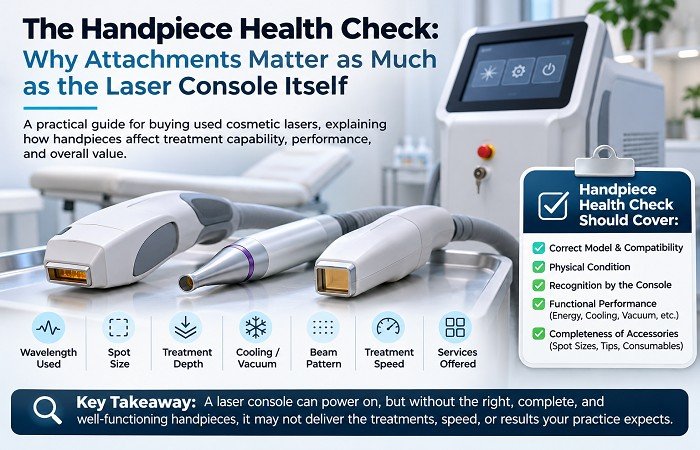
Could a laser console power on perfectly and still be unable to perform the treatment that justified the purchase?
Yes. A worn, incomplete, or incompatible handpiece can leave an otherwise functional console unable to deliver the treatment speed, precision, cooling, wavelength, or coverage the practice expected.
That is easy to miss when comparing used cosmetic lasers for sale. Most listings put the model, year, console, and price front and center. The attachments may appear in one photo or get reduced to a short line under “System Includes.”
Yet those attachments often determine what the equipment can actually do.
Before buying a used cosmetic laser, it pays to look beyond the base unit. This guide explains how handpieces affect treatment capability, where hidden costs can appear, and what should be checked before the system enters a booked treatment room.
The Console Is Only Half of the Treatment System
The console may generate the energy, but the handpiece controls how that energy reaches the treatment area.
Depending on the platform, the attachment may determine:
- The wavelength used
- The available spot size
- Treatment depth
- Cooling or vacuum assistance
- Beam pattern
- Scanner movement
- Treatment speed
- Which services can be offered
The difference can be significant even when two handpieces connect to the same base.
Take the Lumenis LightSheer DUET. Its ET handpiece uses a 9 × 9 mm spot with ChillTip contact cooling, making it useful for smaller areas that require more control. The HS handpiece uses a much larger 22 × 35 mm spot with vacuum assistance, allowing faster coverage of areas such as the back and legs. The console is the same, but the handpieces create very different treatment workflows.
A LightSheer DUET sold with only one of those attachments does not offer the same practical value as a complete system.
The base may still work. The treatment range, appointment speed, and package options are what change.
A Missing Handpiece Can Remove an Entire Service From the Menu
On many multi-application systems, each handpiece unlocks a different treatment category.
A base unit may be compatible with hair removal, pigmentation, vascular treatments, resurfacing, or tattoo removal, but compatibility does not mean those services are automatically included.
The required attachment still has to come with the system.
PicoWay is a clear example. Candela lists different applicators and wavelengths for different tattoo colors and skin-focused treatments. Its 532 nm option is used for colors such as red, yellow, and orange, while 730 nm and 785 nm options are associated with green and blue inks. The 1064 nm handpiece supports darker ink colors, and Resolve attachments serve separate skin applications.
A PicoWay console without the wavelength attachment required for the planned tattoo colors may still be a functioning console. It is not a complete treatment setup for that service.
This is where a low listing price can become misleading. The cost of sourcing a missing handpiece, verifying compatibility, servicing it, and waiting for delivery may erase the original savings.
Handpiece Condition Affects More Than Treatment Quality
A handpiece that looks complete in photos may still have problems that affect daily use.
Those problems can show up through:
- Inconsistent energy delivery
- Weak or unreliable cooling
- Damaged optics or treatment windows
- Loose connectors
- Worn cables or strain relief
- Scanner movement that no longer holds the selected pattern
- Vacuum that fails under use
- Tip-recognition errors
- Missing spot-size components
- Consumables that are difficult to source
A basic power-on test will not reveal all of that.
The FDA has emphasized that proper servicing is critical to the continued safe and effective use of reusable medical devices. Poor-quality servicing can contribute to poor performance, malfunction, and adverse events.
That makes functional testing more valuable than appearance alone. The handpiece needs to be evaluated as part of the operating system, not photographed beside it as an accessory.
What a Proper Handpiece Health Check Should Cover
The exact inspection will vary by platform, but several areas deserve attention before any attachment is considered treatment-ready.
Correct Model and Compatibility
The handpiece model should match the console, software, wavelength, connector, and treatment application.
Similar-looking attachments may not be interchangeable. A handpiece from another generation may connect differently, require different software, or fail to unlock the intended treatment.
Model numbers and configuration details should be confirmed against the actual system, not assumed from appearance.
Physical Condition
The exterior can reveal signs of deeper wear.
Check the housing, cable, connector, buttons, treatment window, optics, strain relief, and any removable components. Cracks, discoloration, frayed cables, cloudy windows, loose connections, or heavy wear deserve closer investigation.
Cosmetic wear does not always mean poor performance. It should still be documented so the buyer understands the actual condition of the equipment.
Recognition by the Console
The system should identify the attachment correctly.
An unrecognized or intermittently connected handpiece can create errors, stop treatments, or prevent access to specific settings. Recognition should remain stable while the cable and connector are moved through normal operating positions.
Performance Under Load
A startup screen confirms very little about how the handpiece behaves during use.
Testing should evaluate the functions the attachment was designed to provide. Depending on the equipment, that may include energy output, pulse delivery, scanner movement, needle motion, vacuum response, cooling, suction, or tip engagement.
A handpiece that passes a visual review may still fail once it is asked to perform repeatedly.
Cooling and Comfort Features
Cooling is not a minor extra on systems designed around epidermal protection or patient comfort.
For example, Lumenis specifies ChillTip contact cooling for its ET handpiece and vacuum assistance for its HS handpiece. A failure in either feature changes how the attachment was designed to operate.
Cooling temperature, contact, flow, spray, or vacuum response should be checked according to the platform.
Usage and Remaining Service Life
Some systems track pulses, shots, lamp usage, tip counts, or handpiece-specific activity.
Those numbers need context. A high count does not automatically make an attachment unusable, and a low count does not guarantee excellent condition. Usage data should be reviewed alongside performance, maintenance, replacement history, and current output.
Included Accessories
The handpiece itself may require additional parts before it can be used.
That may include:
- Distance gauges
- Spot-size adapters
- Filters
- Tips
- Cartridges
- Fibers
- Cooling components
- Foot pedals
- Cables
- Protective eyewear
- Treatment cards or software access
A system described as “complete” should be checked against the components required for the intended service.
Different Attachments Have Different Failure Points
A useful inspection should reflect the technology being purchased. One generic checklist will not reveal every issue across every type of equipment.
Hair-Removal Handpieces
Hair-removal attachments may rely on contact cooling, vacuum assistance, distance gauges, interchangeable spot sizes, or integrated diode arrays.
A proper review should examine:
- Treatment window condition
- Cooling or vacuum performance
- Cable and connector integrity
- Spot-size components
- System recognition
- Energy output
- Shot or pulse data when available
The attachment also affects appointment speed.
A large-area handpiece may make back and leg treatments more practical, while a smaller cooled handpiece supports precision on the face, underarms, or bikini line. Losing one can reduce the packages the practice can sell, even when the console remains operational.
Tattoo-Removal Handpieces
Tattoo-removal systems often depend on wavelength-specific handpieces.
Those wavelengths influence which ink colors and applications the system can support. The inspection should confirm the actual wavelength, optics, spot-size controls, distance gauges, beam delivery, and accessories included with each attachment.
The full package matters. A console advertised as a multi-wavelength tattoo-removal platform may offer far less value when one of the key wavelength handpieces is missing.
IPL Handpieces
IPL attachments may contain or rely on flashlamps, treatment windows, filters, lightguides, cooling components, and system-specific connectors.
The review should cover:
- Lightguide and treatment-window condition
- Included filters
- Cooling response
- Pulse history when available
- Recognition by the base
- Output consistency
- Cracks, clouding, or visible heat damage
A missing filter can remove the treatment category it was meant to support.
Resurfacing Scanners
Fractional and ablative lasers may use scanners to control treatment patterns, density, size, and coverage.
The scanner should be tested for:
- Smooth movement
- Pattern accuracy
- Density selection
- Stable connection
- Cable condition
- Recognition by the console
- Included tips or adapters
A working laser source cannot compensate for a scanner that skips, stalls, or fails to hold the selected pattern.
RF Microneedling Handpieces
RF microneedling attachments combine mechanical movement with energy delivery.
The review may need to cover:
- Needle movement
- Depth adjustment
- Tip recognition
- Electrical contacts
- RF delivery
- Cartridge connection
- Motor response
- Availability of compatible tips
The handpiece may look fine while the depth mechanism or tip connection fails during treatment.
The Cheapest Listing May Cost More Once It Is Treatment-Ready
The console price is only one part of the purchase.
The more useful number is the amount required to place the complete system into service.
That may include:
- Missing handpieces
- Repairs
- Replacement optics
- Cooling work
- Scanner service
- Accessories
- Calibration
- Training
- Shipping
- Consumables
- Downtime while missing parts are sourced
A lower-priced console with an incomplete attachment package may cost more than a slightly higher-priced system that is already configured for the treatments behind the purchase.
The delay matters too.
Every week spent sourcing a missing handpiece is another week the equipment cannot support appointments or begin recovering its cost.
Red Flags in Used Cosmetic Laser Listings
Some listings show the console from every angle and barely mention the attachments.
That should slow the purchase down.
Watch for:
- No close-up photos of the handpiece
- No model or serial details for the attachment
- No list of included handpieces
- “Powers on” used as the only test result
- No confirmation of cooling, vacuum, scanner, or needle function
- A handpiece listed as included but not tested
- Missing spot-size adapters, filters, or distance gauges
- No information on pulses, shots, or usage when the system records them
- Unclear consumable availability
- No service or support after delivery
- No written confirmation of the final equipment package
A clean console does not answer any of those questions.
Compare Complete Treatment Setups, Not Model Names
When reviewing used cosmetic lasers for sale, compare what each system can place on the treatment menu from the day it arrives.
Look at:
- The exact handpieces included
- The treatments each attachment supports
- Wavelengths and spot sizes
- Cooling or comfort technology
- Usage data
- Service history
- Required consumables
- Replacement-part availability
- Inspection results
- Warranty and post-purchase support
This gives a far more accurate picture of value than comparing the year and base-unit price alone.
A complete system with tested attachments may cost more upfront, but it can enter the schedule sooner and avoid a second round of equipment spending.
How We Review the Whole System at The Laser Agent
At The Laser Agent, the console and its attachments are treated as one equipment package.
We are a Certified Pre-Owned laser dealer, not a broker passing along another seller’s listing. Because we own our inventory, our team can review the actual system, included handpieces, accessories, service information, and condition before it ships. Eligible systems also go through our comprehensive 50-point inspection, and post-purchase service support is available after delivery.
This matters because the treatment value is rarely contained in the console alone.
A laser earns its place in the room when the full setup supports the appointments, speed, comfort, and services behind the purchase.
Buy the Treatment Capability, Not Only the Console
The handpiece is where the machine becomes a treatment.
It can control the wavelength, spot size, cooling, speed, precision, depth, and service category tied to the system. A worn, incomplete, or untested attachment can limit appointments, increase costs, and delay the return expected from the purchase.
Before choosing among used cosmetic lasers for sale, confirm the exact handpieces, what each one supports, how they were tested, and which accessories come with them.
A lower console price means very little when the system cannot perform the treatment that made it worth buying.
Reach out to us at The Laser Agent to compare Certified Used cosmetic lasers by handpiece package, configuration, condition, warranty options, financing, and nationwide delivery.